Short answer: To verify a Muslim rishta, check in layers: confirm identity and address, then education and work, then family background through people who know them, then marital status and any earlier nikah or divorce papers, and finally meet with family present. Never send money before the nikah. Verification reduces risk but cannot guarantee character.
A rishta is one of the biggest decisions a family makes, and families often decide with limited information. Fake profiles, hidden marital status and money scams are real risks, especially when the first contact is online. This checklist helps you ask the right questions calmly and respectfully. If you would like help from a team that screens profiles before introductions, see our guide to Muslim matrimony across India.
Why verify a rishta?
Most rishtas are genuine, and verifying should not feel like an accusation. It is simply a sensible step, just as families ask about each other through relatives. Common problems to guard against include:
- a profile with someone else's photographs or a false identity
- a hidden earlier marriage, or hidden divorce or separation
- exaggerated education, job or income
- pressure to move quickly, share documents or send money
- someone who contacts the girl directly and bypasses the family
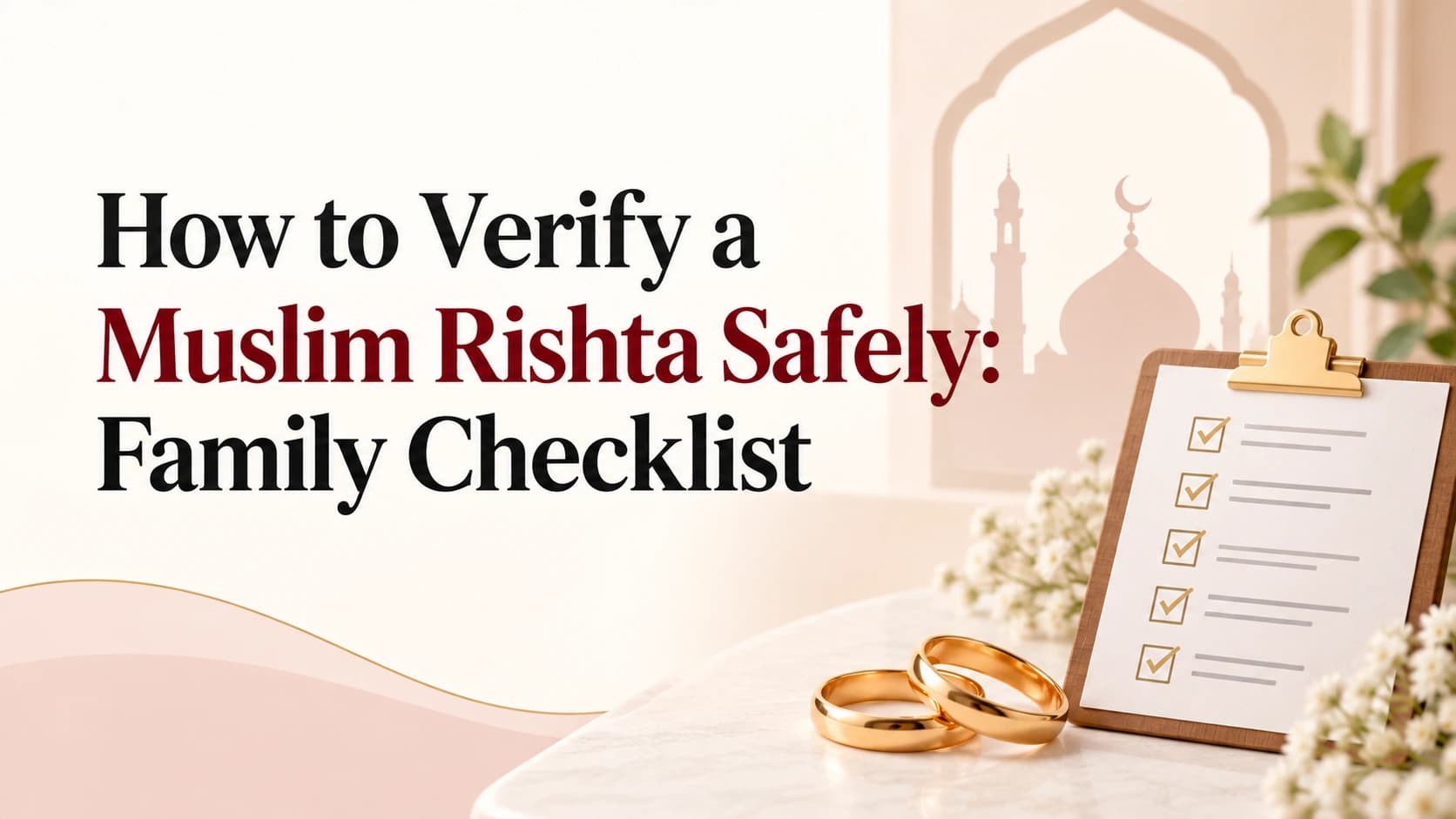
The 8-step verification checklist
- Confirm who is behind the profile. Speak to the family, not only the person. Ask for a video call with parents or guardians present. A genuine family will understand why you ask.
- Check identity and address. Ask to see a government ID such as Aadhaar or PAN, and proof of address. Never share your own ID numbers, bank details or OTPs in return.
- Check education. Ask for degree certificates or mark sheets. If it matters, confirm with the institution.
- Check work. Ask for an offer letter, ID card or payslip. For business families, ask how and where the business operates. Be proportionate: ask what you need to know, not everything at once.
- Ask about the family through people who know them. Speak to relatives, neighbours, the local mosque or jamaat and former colleagues. Ask more than one person.
- Check marital status. Ask whether the person has been married before, and ask for the papers if so. See the next section.
- Look at public information. Check whether public social media profiles match the story and the photographs. Do not demand private account access.
- Meet with families and a trusted elder. Meet in a comfortable, public or family setting. Take your time. A genuine family will not rush you.
If any answer does not match, ask politely again. If it still does not match, pause.
How to check marital status, a Nikahnama or a divorce paper
If a person has been married before, the family should be open about it. Ask for copies of the papers and read them carefully.
- Nikahnama or marriage certificate: check that the names, dates and places are consistent, and see who issued it, such as a qazi, a registrar or another office.
- Divorce or separation papers: ask for the paperwork that shows how and when the earlier marriage ended, and check that the dates make sense.
- If a spouse has died: a death certificate is normally available.
Whether a marriage certificate can be checked online depends on the state and on how the marriage was registered. Do not assume an online check exists. If something is unclear, ask the family for originals, check with the issuing office, or speak to a lawyer. This is general information, not legal advice.
Online red flags
Slow down if a person:
- refuses video calls or always has an excuse
- wants to move to private chat quickly and avoids involving family
- has photographs that look too perfect or that do not match across profiles
- tells stories that change or do not add up
- claims an urgent crisis and asks for money, gift cards or "customs fees"
- is based abroad and pushes for a quick decision or an online nikah without any checks
- makes you feel guilty for asking questions
One red flag is a reason to ask more questions. Several together are a reason to stop.
Money and gold: simple safety rules
- Never send money, gifts or "fees" before the nikah. A genuine rishta never needs this.
- Never share OTPs, passwords or card details. No one involved in a rishta needs them.
- Keep all agreements between the families open and written, including mahr.
- Do not ask for or accept dowry.
- If a bureau asks for money, ask for written terms and a receipt. Read our guide to choosing a Muslim marriage bureau.
How to ask for verification without offending the other family
Many families hesitate to ask for documents because they fear it sounds like mistrust. It does not have to. A few simple habits help:
- Say that you ask every family the same questions. This makes it a process, not a suspicion.
- Start gently. Begin with family background and education, and ask for documents once both sides are serious.
- Offer the same in return. Share your own references and details, so the exchange is fair.
- Let elders handle sensitive questions, such as earlier marriages and finances. A respected elder can ask these with care.
- Ask in conversation, not in a demanding message. A phone or in-person talk sets a better tone than a list of demands.
- Pause rather than argue. If something does not feel right, thank the family, take time and decide calmly.
A genuine family will usually respect a careful approach. If a family becomes angry or evasive only because you asked reasonable questions, treat that as information too.
What documents show, and what they do not
Documents prove facts such as name, age, address, degree and job. They do not prove character, temperament or how a person treats their family. That is why meetings, references and time matter as much as papers. Use verification as one layer of a careful process, along with istikhara, consultation with elders and your own judgement.
What HumNikah checks, and what we do not
Every profile is manually screened, and we ask for identity and address documents. We do not run formal criminal-record checks, and no bureau can promise a perfect outcome. We encourage every family to make its own enquiries as well, using the checklist above.
If you would like to know how we verify profiles before making introductions, message our team on WhatsApp or read our FAQ.
Quick checklist to save
- I have spoken to the family, not only the person.
- I have seen ID and address proof.
- I have checked education and work.
- I have asked more than one person about the family.
- I know whether there was an earlier marriage, and I have seen the papers.
- I have not sent money or shared OTPs.
- Both families have met.
- I have taken time to decide.
Ready to begin?
Start your search with a team that screens profiles and involves the Wali. Not sure how to write your biodata? Use our free Muslim biodata format.
Chat on WhatsApp · Submit your biodata · or call +91 9019082205
FAQs
Do you run criminal background checks on profiles?
No. We manually screen each profile and check identity and address documents, but we do not run formal criminal-record checks. We encourage families to make their own enquiries too.
Which ID is used to verify a rishta?
A government ID such as Aadhaar or PAN is commonly used, along with proof of address. Never share your own ID numbers with anyone you have not verified.
What should I do if a rishta profile looks fake?
Stop sharing personal information, do not send money, and ask for a video call with the family. If the answers do not match, end the contact, and report the profile to the platform or bureau it came from.
How can I check a Muslim marriage certificate?
Ask the family for copies, check that names, dates and the issuer are consistent, and confirm with the issuing office if needed. Whether a certificate can be checked online depends on the state and on how the marriage was registered. This is general information, not legal advice.
Is it rude to ask for documents?
No. Careful families ask for them politely, and genuine families expect it. Explain that you ask every family the same questions.
HumNikah Editorial Team
Nikah & family guidance
Providing authentic Islamic guidance for single Muslims, parents, and newlyweds embarking on Nikah.